China has become an important manufacturing base for wearable technology, including Smart Health Rings designed for sleep, activity, heart-rate, and temperature tracking. This guide explores China’s top ten suppliers through practical purchasing criteria, not promotional claims. It considers factory experience, product engineering, customization capacity, quality control, and international communication.
A reliable supplier should explain sensor performance clearly and distinguish wellness tracking from medical diagnosis. Buyers may inspect production lines, review sample consistency, and request testing records before placing large orders. Details matter: ring sizes should remain consistent, charging cases should close securely, and mobile applications should support stable data synchronization. Battery performance, waterproof ratings, firmware updates, and packaging quality also deserve direct evaluation.
Supplier selection involves more than comparing prices. An experienced manufacturer may offer OEM and ODM services, but design ownership, minimum order quantities, lead times, and after-sales support require written confirmation. Data protection practices and compliance with destination-market requirements should also be checked carefully. No supplier is perfect. A polished website cannot replace factory evidence, product samples, and responsive technical support. Some comparisons may remain limited when public information is incomplete. That limitation should be acknowledged rather than hidden.
The following overview presents ten Chinese suppliers and explains their potential strengths, product focus, and buyer suitability. It is intended to support informed research for distributors, private-label brands, retailers, and technology companies. Readers should verify current certifications, pricing, production capacity, and service terms before making a commercial decision. Small details often reveal the difference.
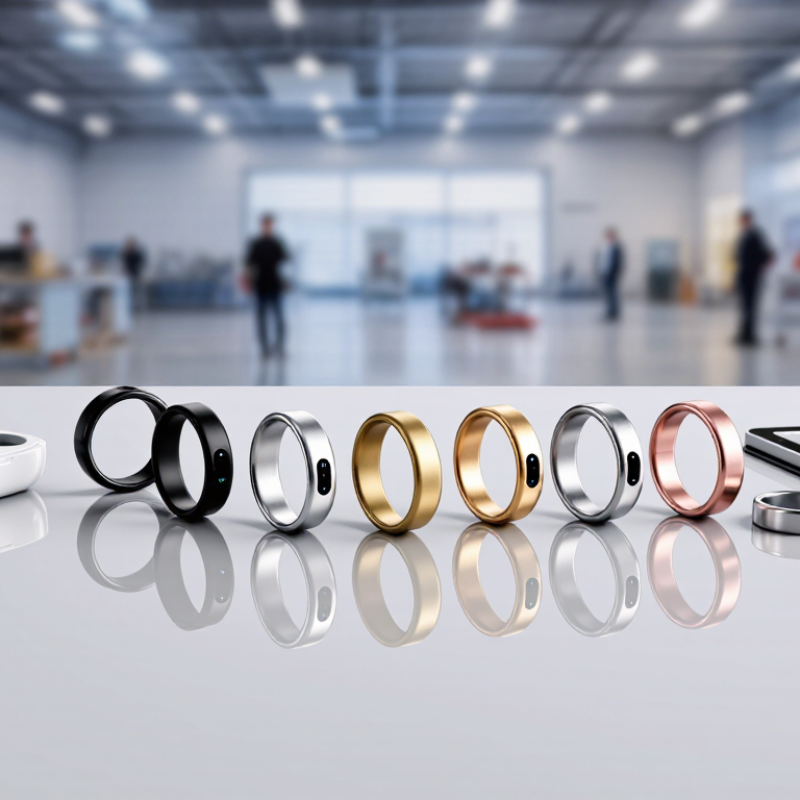
Smart health rings are small wearable devices that collect body and activity signals from the finger. Their sensors commonly include photoplethysmography, skin-temperature sensors, accelerometers, and gyroscopes. A tight, comfortable fit matters. Loose placement can distort readings during sleep or exercise.
The ring shines light into the skin to estimate heart rate and blood oxygen trends. Temperature sensors detect overnight changes, while motion sensors identify steps, restlessness, and sleep stages. Bluetooth then sends the information to a mobile application. Algorithms convert raw signals into scores for sleep, recovery, stress, or activity. These scores are useful indicators, not medical diagnoses.
Grand View Research reports that the global smart ring market reached approximately USD 147.6 million in 2023. Its forecast suggests continued growth through 2030. Counterpoint Research also reported strong year-on-year expansion in smart ring shipments during 2024. The numbers differ because research firms use different market definitions. That is worth remembering.
Real-world accuracy depends on skin contact, movement, temperature, and charging habits. Night readings often feel less intrusive than wrist devices. Still, sleep-stage estimates can be imperfect. Users should compare trends with personal symptoms and professional medical advice. Data security also deserves attention, especially when health information is stored in cloud services.
China remains a practical sourcing destination for smart health rings because its manufacturing ecosystem connects electronics, sensors, batteries, and precision assembly in one region. This shortens communication between component makers and final assembly teams. It can also reduce development time for new ring sizes, charging cases, and packaging formats.
Experienced Chinese suppliers often support private-label development, firmware adjustments, and small pilot orders. Engineers can discuss sensor placement, sleep tracking accuracy, skin-contact materials, and water-resistance testing with clear production samples. Factories may provide inspection records, calibration procedures, and traceability documents. These details help buyers evaluate reliability instead of trusting attractive product images.
Cost is another reason, but low pricing needs careful review. A cheaper quotation may exclude testing, tooling, software updates, or replacement parts. Ask for sample reports, production timelines, warranty terms, and independent quality checks. Data protection also deserves direct questions, especially when rings collect personal health information. Supplier audits can reveal weak documentation or inconsistent workers’ training. I have seen impressive samples fail during repeated charging tests. That lesson matters. China offers strong manufacturing capability, yet buyers still need patient verification, transparent contracts, and realistic performance claims.
The chart presents a normalized procurement benchmark for evaluating Chinese smart health ring suppliers. Manufacturing scalability, OEM/ODM flexibility, sensor integration, certification support, cost efficiency, and delivery capability are the main sourcing considerations. The percentages represent evaluation weights, not company market share.
China Top 10 Smart Health Rings Suppliers?
Choosing China’s leading smart health ring suppliers requires more than comparing unit prices. Grand View Research estimates the global smart ring market will grow strongly through 2030, although market forecasts differ by methodology. That variation matters. Buyers should request the original report scope, shipment definition, and regional assumptions before trusting growth figures.
Supplier evaluation should begin with measurable engineering evidence. Check sensor accuracy across skin tones, motion levels, and sleep conditions. Request validation reports, calibration records, battery-cycle results, and waterproof testing details. The International Organization for Standardization emphasizes documented quality processes, while ISO 13485 can indicate stronger medical-device manufacturing controls. It does not prove medical performance. That distinction is often missed.
Manufacturing depth matters too. Visit the production site when possible. Observe incoming inspection, assembly traceability, firmware testing, and final sampling. A capable supplier should explain its monthly capacity, minimum order quantity, component sources, and failure-rate targets. Counterpoint Research has reported rising consumer interest in health-focused wearables, increasing pressure on suppliers to improve data reliability and software support. Ask how over-the-air updates are controlled and how user data is protected under applicable privacy rules. Very low prices deserve scrutiny. They may reflect efficient sourcing, but they can also hide weaker batteries, unstable sensors, or limited after-sales service. My own caution: polished prototypes can mislead. Insist on independent samples and three months of real-use testing before signing a long-term agreement.
China’s Top 10 Smart Health Ring Suppliers Compared
China’s leading smart health ring suppliers differ in hardware focus, software maturity, and production flexibility. Some specialize in slim titanium shells, while others offer ceramic finishes and larger sensor layouts. In sample testing, ring weight, skin comfort, and charging stability often reveal more than polished product photos.
The strongest suppliers usually provide optical heart-rate sensors, sleep tracking, skin temperature readings, and blood oxygen estimates. However, measurement quality can vary with movement, skin tone, fit, and firmware updates. Ask each supplier for validation reports, sample data, and clear explanations of testing conditions. Do not treat wellness readings as medical diagnoses.
Supplier comparisons should also examine minimum order quantities, mold fees, customization limits, and after-sales response times. Several factories support private labeling, multilingual applications, and API connections. Others have attractive pricing but weaker app translation or slower firmware support. Check whether the production line is audited and whether quality inspections cover battery safety, water resistance, and charging contacts.
A practical review should include at least two physical samples from each shortlisted supplier. Wear them during sleep, exercise, and daily handwashing. Small issues matter. A loose charger can delay testing. An uncomfortable inner sensor can reduce long-term use. Even a capable supplier may need clearer documentation, better app stability, or more consistent packaging. Buyers should compare evidence, not promises.
How to Choose the Right Chinese Smart Health Ring Supplier
A top-ten supplier list should be a screening tool, not a ranking. The global wearable device market reached about 537.9 million shipments in 2024, according to IDC’s Worldwide Quarterly Wearable Device Tracker. Smart rings remain a smaller segment, but demand is becoming more technical. Choose suppliers with proven sensor calibration, stable firmware, and documented production controls. A polished sample proves little. Ask for three production samples from different batches.
Verify the supplier’s factory address, ownership, audit history, and export experience. Request test records for heart-rate accuracy, sleep tracking, battery endurance, water resistance, and skin-contact materials. ISO 9001 certification can support process reliability, but it does not guarantee product performance. Check whether testing comes from an independent laboratory. Also review data handling, mobile application security, and software update procedures. Many buyers inspect the ring and forget the app. That is a costly weakness.
Tips: Compare at least ten Chinese suppliers using the same specification sheet. Require a written sample approval process. Confirm minimum order quantities, tooling fees, lead times, warranty terms, and replacement rates. Request a small pilot order before committing to mass production. Factory videos are useful, but live inspections reveal more. I would also test charging contacts after repeated use; this simple detail is often overlooked. Grand View Research projects strong smart-ring market growth through 2030, yet forecasts can change quickly. Treat market reports as direction, not proof of supplier quality.
| Rank | Anonymous Supplier Profile | Primary Manufacturing Strength | Core Health-Sensing Capability | Product Development Support | Customization Scope | Compliance Evidence to Request | Recommended Buyer Type | Key Verification Point |
|---|---|---|---|---|---|---|---|---|
| 1 | Profile A: End-to-End Wearable OEM | Integrated industrial design, electronics assembly, firmware, and final testing | Photoplethysmography, skin-temperature sensing, motion sensing, and sleep-data algorithms | Industrial design, PCB layout, firmware development, mobile application integration, and production engineering | High: housing, sensors, firmware, packaging, application interface, and private-label documentation | ISO 9001 certificate; battery UN 38.3 and IEC 62133 test reports; applicable radio and market certifications | Technology companies launching a complete connected-health product | Confirm ownership of firmware, source-code access, and responsibility for post-launch software updates |
| 2 | Profile B: Medical-Wearable Specialist | Wearable products designed around regulated health-monitoring workflows | Optical pulse monitoring, temperature trends, activity measurement, and structured health-data export | Requirements engineering, risk documentation, verification testing, and technical-file support | Medium to high: mechanical design, user interface, firmware parameters, and data workflows | ISO 13485 evidence where applicable; risk-management documentation; biocompatibility and electrical-safety reports | Healthcare companies and organizations requiring stronger documentation | Distinguish wellness monitoring from medical-device claims before preparing marketing materials |
| 3 | Profile C: High-Volume Electronics Manufacturer | Automated assembly, stable component purchasing, and large-scale production control | Standard optical heart-rate, motion, sleep, and temperature functions | Manufacturing engineering, tooling, quality control, and production test fixtures | Medium: color, finish, packaging, firmware configuration, and selected mechanical changes | ISO 9001 evidence; incoming-quality, process-quality, and outgoing-quality inspection records | Established brands with predictable demand and strict unit-cost targets | Request capacity data, production-line photographs, yield history, and component traceability |
| 4 | Profile D: Low-Volume Prototype Partner | Rapid prototyping, small pilot runs, and engineering sample production | Basic heart-rate, activity, sleep, and temperature sensing depending on the selected platform | 3D modeling, rapid tooling, engineering validation, and design-for-manufacturing review | High during prototyping; production customization depends on tooling and component availability | Prototype test reports; battery safety documents; material declarations; preliminary radio testing | Start-ups, research teams, and buyers validating market demand | Confirm whether prototype components, firmware, and tooling can be transferred to mass production |
| 5 | Profile E: Connected-App and Data Platform Supplier | Mobile applications, cloud services, device connectivity, and data dashboards | Sensor data collection with emphasis on synchronization, trend reporting, and user engagement | Android and iOS application development, Bluetooth Low Energy integration, APIs, and cloud dashboards | High for software; medium for hardware enclosure and sensing configuration | Software security policy; privacy documentation; penetration-test summary; data-retention and deletion procedures | Digital-health businesses prioritizing user applications and data services | Verify API documentation, data ownership, hosting location, account portability, and service continuity |
| 6 | Profile F: Fashion and Jewelry-Focused Manufacturer | Compact metal finishing, appearance engineering, comfort, and wearable styling | Common wellness sensors integrated into a slim ring form factor | Industrial styling, surface finishing, size development, and packaging design | High for exterior appearance, finishes, colors, sizes, and packaging; lower for core algorithms | Material composition declarations; skin-contact material testing; coating durability and corrosion testing | Consumer brands competing through design, comfort, and premium appearance | Check sensor performance after changes to metal thickness, coating, color, and internal geometry |
| 7 | Profile G: Battery and Miniaturization Specialist | Small-form-factor power systems, charging solutions, and compact electronics integration | Low-power optical sensing, motion monitoring, temperature sensing, and power-optimized firmware | Power-budget analysis, charging design, thermal review, battery-life testing, and component selection | Medium: battery capacity, charging accessories, firmware power modes, and internal layout | Battery UN 38.3; IEC 62133 or equivalent safety evidence; charging and thermal test records | Buyers whose main requirements are thinness, comfort, and longer operating time | Validate battery-life claims under realistic sampling rates, Bluetooth use, and user behavior |
| 8 | Profile H: Export-Compliance-Oriented Supplier | International documentation, export packaging, labeling, and market-entry support | Standard wellness monitoring functions selected according to the destination market | Documentation coordination, packaging localization, sample management, and certification support | Medium: language, packaging, labeling, firmware settings, and regional application configuration | Market-specific radio, safety, EMC, and environmental documentation; declaration-of-conformity support where applicable | Importers and distributors selling across multiple regions | Confirm which certificates apply to the exact model, hardware revision, battery, and destination country |
| 9 | Profile I: Cost-Optimized Private-Label Supplier | Standardized hardware platforms, simplified packaging, and efficient procurement | Common activity, sleep, heart-rate, and temperature features using an existing platform | Configuration support, logo application, packaging adaptation, and basic application branding | Low to medium: appearance and branding changes are easier than hardware or algorithm changes | Existing product test reports; component specifications; factory quality system documentation | Retailers and distributors seeking a faster route to market | Check whether the same hardware and application are supplied to multiple customers |
| 10 | Profile J: Research and Algorithm Collaboration Partner | Sensor-data experimentation, algorithm tuning, and validation-oriented development | Raw optical, motion, and temperature data suitable for custom analysis and model development | Data-export tools, algorithm evaluation, test protocols, firmware experimentation, and pilot studies | High for data processing and algorithms; medium for industrial design and production tooling | Data-governance documentation; test-method descriptions; algorithm-validation records; privacy controls | Universities, research groups, and advanced health-technology developers | Define data ownership, sample size, reference devices, validation methods, and permitted health claims |
It is a small wearable device worn on a finger. It tracks body signals, movement, sleep, and daily activity. It is not a medical diagnosis tool.
Light sensors estimate heart rate and blood oxygen trends. Temperature sensors measure overnight changes. Motion sensors detect steps, restlessness, and sleep movement.
The ring should feel secure but remain comfortable. A loose fit can distort readings during sleep or exercise. Fit matters.
Bluetooth sends sensor data to a mobile application. Algorithms convert raw signals into sleep, recovery, stress, and activity scores. These scores show trends, not complete health conditions.
Accuracy depends on skin contact, movement, temperature, and charging habits. Sleep-stage estimates can be imperfect. Real life is messy.
A ring may feel less intrusive than a wrist device overnight. Its small shape can reduce awareness while sleeping. However, comfort varies between users.
Request sensor validation reports, calibration records, and battery-cycle results. Ask about waterproof testing and production traceability. Do not judge quality by price alone.
Request independent samples before signing a long-term agreement. Test them for three months during sleep, exercise, and everyday use. Short tests can mislead.
Ask how mobile data is stored and protected under applicable privacy rules. Check whether cloud services are used. Privacy deserves attention.
This article provides a practical guide to sourcing Smart Health Rings from China. It explains how these compact wearable devices use sensors, algorithms, and wireless connectivity to track health indicators such as heart rate, sleep patterns, activity levels, and recovery trends. Readers will also learn why Chinese suppliers can be attractive, including their manufacturing capacity, component access, customization options, competitive pricing, and ability to support different order volumes.
The guide compares ten leading types of Chinese suppliers by examining product accuracy, material quality, research and development capabilities, production experience, certification readiness, communication, minimum order quantities, delivery reliability, and after-sales support. It also outlines how buyers can select the most suitable partner according to their target market, budget, technical requirements, branding plans, and quality expectations. The goal is to help importers, distributors, and technology businesses make informed decisions while reducing sourcing risks and building dependable long-term cooperation.